Routledge · Assessment and Improvement in Higher Education series
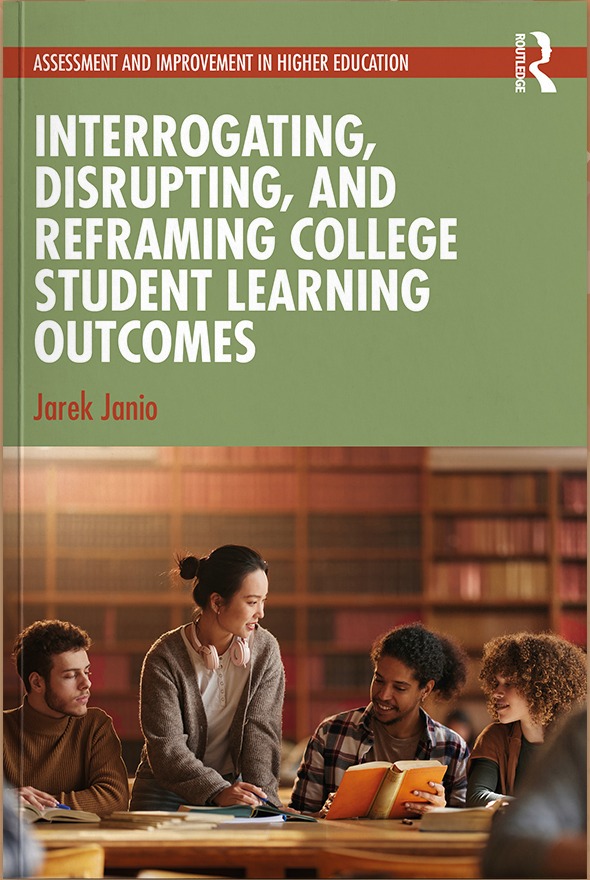
Interrogating, Disrupting, and Reframing College Student Learning Outcomes
Learning is observable behavior: the attainment and demonstration of skill. The question every outcome should answer is simple. What can students do now that they could not do before?
Higher education measures attendance, grades, transfer, and completion with great precision, yet it has never settled on an operational definition of the one thing all of those numbers are supposed to stand for. This book offers one, and shows how a single classroom artifact, read at three altitudes, can carry course, program, and institutional assessment at once.
Get the book at Routledge Watch the conversation with Eric Mazur
Save 20% with code 26ESA3 at routledge.com, valid through 31 December 2026.

Hear the argument
Two conversations, one before the book and one at its release, that walk through the central claim: learning is something we can see, and a course should be able to show the difference between what students could do in week one and what they can do at the end.
In conversation with Eric Mazur
Social Learning Amplified (Perusall), hosted by Eric Mazur of Harvard University · September 2026
In conversation with Stephen P. Hundley
Leading Improvements in Higher Education, hosted by Stephen P. Hundley, who wrote the book’s foreword · January 2025
A conversation with an assessment leader involved in championing student learning outcomes: how the SLO Symposium and Friday SLO Talks communities took shape, and why outcomes work has to start from what students can demonstrably do.
How the argument was built
The book did not appear all at once. Its central claim took shape over several years of shorter pieces, each testing one part of the idea in public. Read in order, they trace the path from a single essay on skill to a full framework for outcomes assessment.
Where it started
- Nothing But Skill The Assessment Review (CUNY) · May 2023 The first statement of the thesis: the only thing that finally matters is what skills and competencies students can demonstrate when the course is over.
- Beyond “Grit” and “Growth Mindsets” Inside Higher Ed · June 2025 Internal traits cannot be taught or measured. Behavior can. Teachers control the conditions that prompt the behaviors that make learning visible.
Learning as behavior: the psychology
From the “How We Learn” column at Psychology Today.
- What Neuroscience Misses About Students Psychology Today · June 2025 Teachers do not need a brain scan to know whether learning happened. Even neuroscience reads its data through behavior; performance is the foundational evidence.
- Motivation Is Speculation, Behavior Is Evidence Psychology Today · August 2025 Stop inferring what students feel inside. Assess what they produce, and make the criteria for success concrete enough to see.
- Beyond Bloom’s Ladder: A New Look at Learning Psychology Today · October 2025 Learning is not a staircase of cognitive levels. It is messy, opportunistic, and observable in what people do in meaningful contexts.
- The Feeling of Learning Can Be a Psychological Illusion Psychology Today · March 2026 A clear explanation feels like understanding. Fluency and competence are different things, and only demonstrated capability tells them apart.
- Student Engagement: Identifying the Illusion of Learning Psychology Today · April 2026 Nodding, smiling, and participating are emotional states, not evidence. The real test is independent performance under new conditions.
Learning as behavior: the institution
From The EvoLLLution, on what the definition means for metrics, accountability, and the academic curriculum.
- Rethinking Metrics in Higher Ed: Moving Beyond Persistence and Retention The EvoLLLution · January 2025 Retention and graduation rates are procedural. They say nothing about what students can do. Institutional success should be anchored in evidence of learning.
- From Apprenticeship to Competency: What Anthropology Can Teach Us About Learning The EvoLLLution · May 2025 · with Donald Gaff Across cultures, apprenticeship has always known that learning must be seen to be assessed. Higher education can relearn the lesson.
- Completion Is Not Competence: Why Accountability Requires a Definition of Learning The EvoLLLution · March 2026 Grades, credit hours, and completion are proxies. Accountability becomes real only when learning is defined as a durable change in what a student can demonstrably do.
- If It’s Not a Skill, What Are Students Learning? The EvoLLLution · April 2026 The academic and vocational divide is false. Every discipline teaches observable skills; academic fields simply hide theirs behind verbs like “understand” and “appreciate.”
- Learning, Undefined: The Missing Anchor in Higher Education Accountability The EvoLLLution · September 2026 Published alongside the book: colleges count enrollment and completion precisely but have never defined learning. Here is the definition the accountability system is missing.
The discussion continues.
Join Praxis Commons A community of practice for faculty and assessment coordinators working out what observable learning looks like in their own classrooms and programs.